It Takes a Village: From Writing Lessons to Diabetes Self-Management
This is an adaptation of a talk given at the 2026 Conference on College Composition and Communication (CCCC) as part of the Medical Rhetoric Standing Group’s panel “Conference as Care in Rhetorics of Health and Medicine.”
How is diabetes like a dissertation? How can writing pedagogy help us find greater success in daily management?
We imagine writing –especially something big, like a dissertation– as solitary labor: one person alone with their thoughts. However, anyone who has written or supervised a dissertation knows it takes a village: advisors, communities of scholars, and trusted readers. Research consistently shows that writers who regularly receive peer feedback are more productive and more likely to succeed.
Psychology professor Robert Boicei found that writers who lacked community support and relied on “binge writing” produced an average of only 17 pages per year. But those who wrote regularly and had support from colleagues produced 157 pages per year.
This made me wonder how the same might be true for PWD. We know that incremental daily practice, goal setting, and peer support equates to success for academic writers.ii Could this also work as a model for PWD to help them build sustainable self-management habits? Raising this question opens up unexamined possibilities for supporting the isolating, daunting, and relentless task of managing diabetes.
Dissertations + Diabetes
The challenges of completing a dissertation are well-documented;iii just as many PWD struggle to meet the health metrics outlined in the American Diabetes Association’s Standards of Care.iv
Lora Arduser, author of Living Chronic: Agency and Expertise in the Rhetoric of Diabetes,v argues that agency in diabetes care is inherently complex: the person with diabetes is in charge, but is also reliant on their HCP for advice and knowledge. This is not unlike the relationship between a graduate student and a dissertation advisor. The project belongs to the graduate student, but the advisor must sign off and retains their position of authority.
In much the same way that an advisor might say “Just write a first draft," the American Diabetes Association encourages PWD to "overcome barriers" when creating an action plan. If only it were so simple.
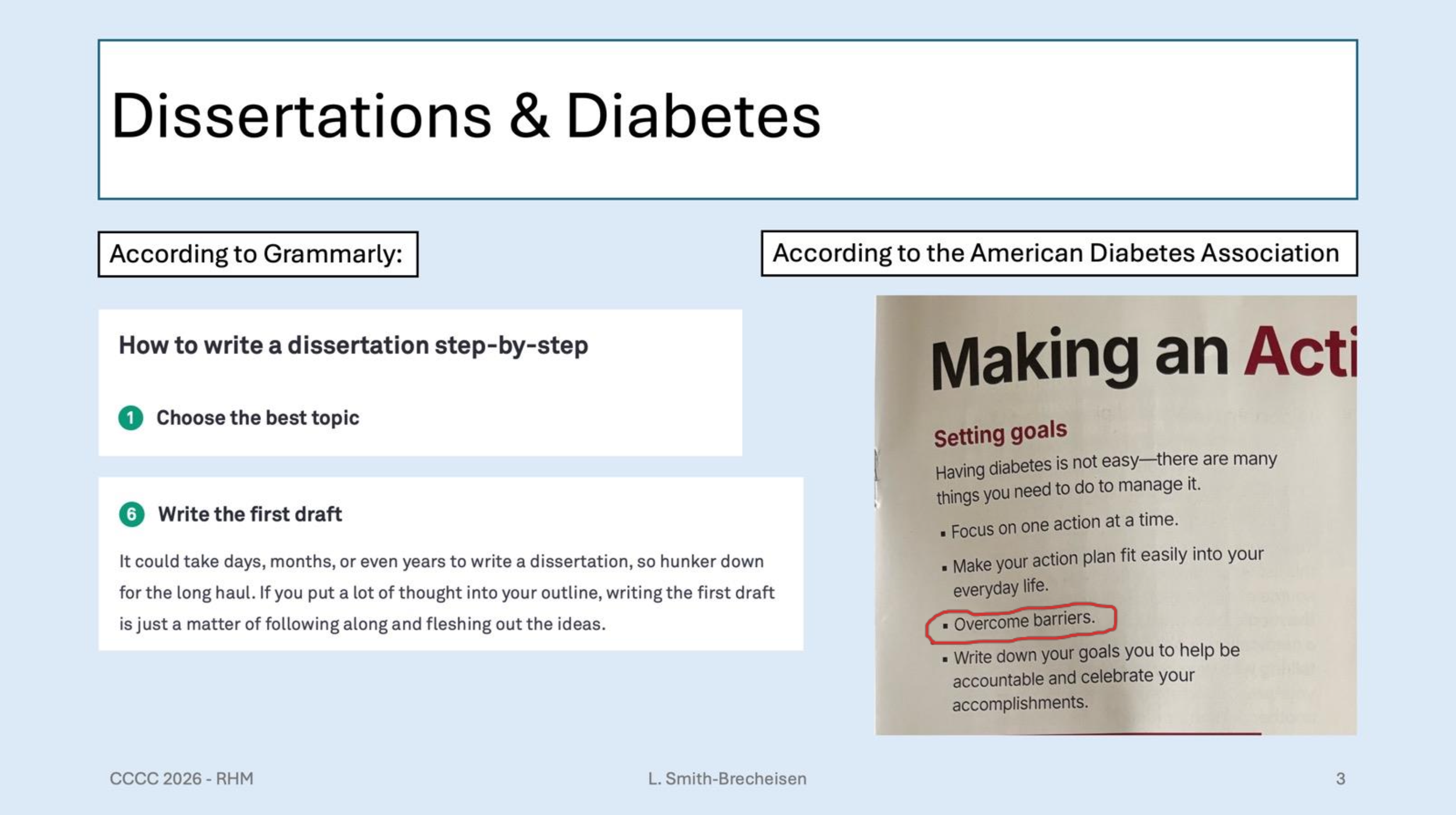
Lists like these get generated for both audiences: you’re in charge, but here’s how to do it. Crucially, the “how” is deeply obscured. Too often PWD are given the “steps” for success, but receive little support about how to do it. We —PWD and academic writers— often cling to lists of seemingly simple steps or rules that often present themselves as a port in the storm, when in reality, they actually make us feel worse if we can’t accomplish such “simple” steps. But of course, they only appear simple in list form.
The Reality of Setting and Meeting Goals
When I work with graduate students, I often have them start by mapping out their writing goals for the semester using a template from the National Center for Faculty Development and Diversity (NCFDD). Rather than vague ambitions like “finish a dissertation chapter,” we start by setting SMART (specific, measurable, attainable, relevant, and time-bound) goals. In this step, they not only reflect on their writing goals, but critically, their personal goals: what do they want to do to make their lives meaningful?
This activity can help them see many of the often-invisible steps involved in completing a large project and how writing goals are connected to their personal goals in some ways and separate from them in others. The same is true for diabetes. As with writing goals, it can help to see the overlap and divergence between diabetes goals and other life goals. After all, we are not our diabetes.
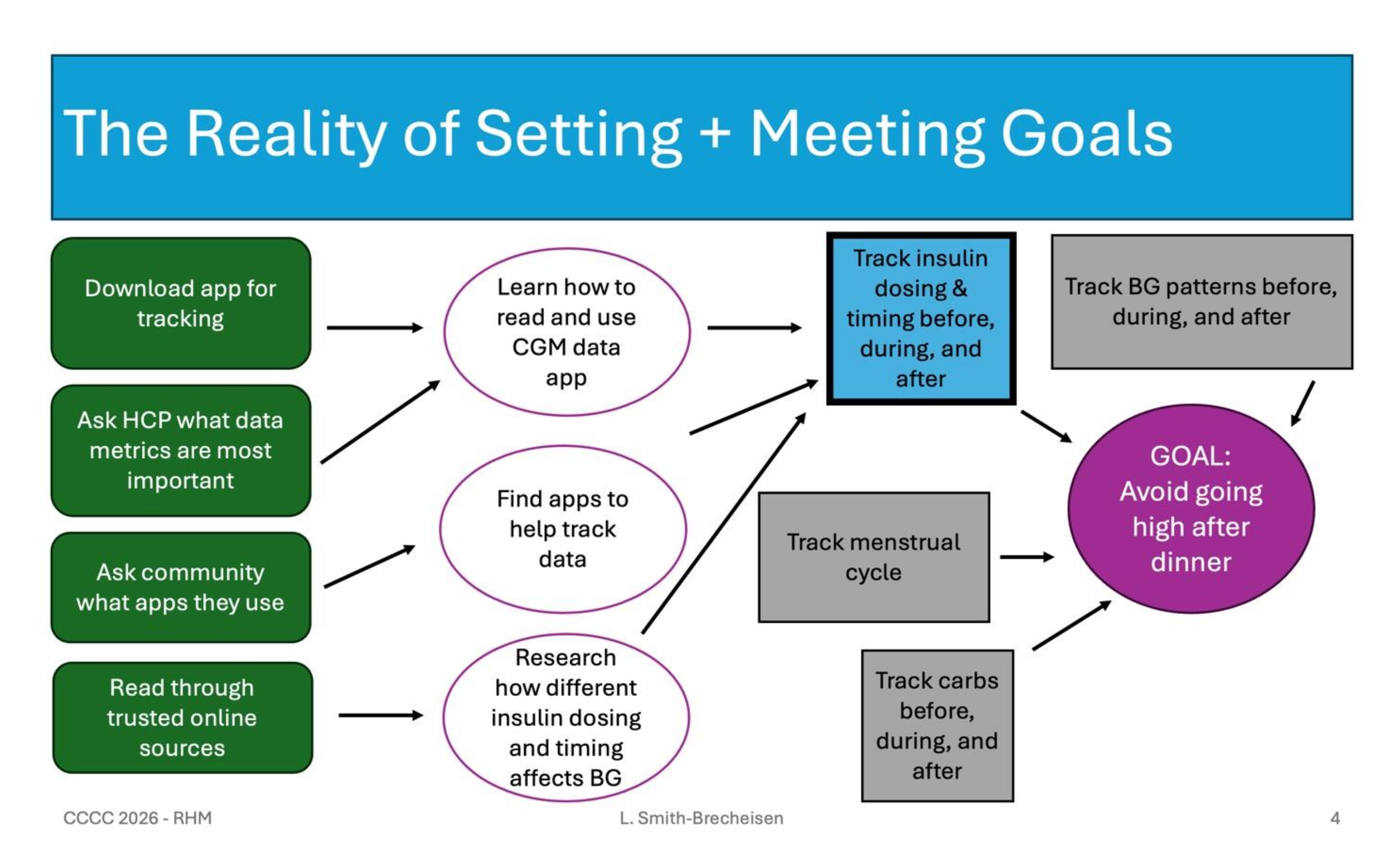
Using a writing goal map to plan diabetes management quickly reveals how much more complex daily care is than a simple checklist suggests. Take a seemingly simple goal: “avoid going high after dinner.” Achieving it requires dozens of small decisions: counting carbohydrates, timing insulin, interpreting glucose patterns, adjusting doses, learning from data, and so on. The hidden work that goes into a seemingly simple decision we make regularly is often taken for granted.
While mapping out the goals can be a very useful step, this alone doesn’t solve everything. In fact, one critical element remains hiding in plain sight: How does someone develop the habits to meet these goals and perform these tasks consistently? This is where accountability groups come in.
Accountability Groups: Daily Practice + SMART Goals + Peer Support
Beyond clinical care, people with diabetes have access to a range of community and peer-support initiatives. While these play an important role in reducing isolation and supporting mental well-being, they do not necessarily lead to building sustainable habits that scaffold over time.
To address this gap, I developed a diabetes accountability group model that uses Robert Boice’s research on daily writing, the NCFDD’s 14-Day Writing Challenge, Arduser’s call for communities of practice, and my own experiences supporting both academic writers and people with diabetes.vi
The model is built on three simple principles:
Incremental daily practice
SMART goals
Peer support
The 14-day accountability groups are meant to help PWD track and make incremental progress on daily management. They are intentionally designed to be time-bound to keep people focused and realistic –an A1c cannot be lowered in two weeks, but foundational habits can begin to emerge.
Like writing a dissertation, living with diabetes is not a sprint but a marathon. The difference is that, unlike a dissertation, diabetes has no finish line.
Preliminary Results
I have now run these groups multiple times through the Beta Cell Foundation and Diabetes Training Camp. Participants consistently move beyond simply understanding diabetes concepts to applying and analyzing, and for some, even creating solutions of their own!vii Just as importantly, regular low-stakes peer check-ins help PWD make meaningfulprogress on their diabetes and personal goals.
The examples below illustrate this process. Questions and challenges (green) evolve into practical solutions (yellow), while participants reflect on their own thinking, decision-making, and goal-setting (blue). In other words, they are not only managing diabetes –they are learning how they learn.
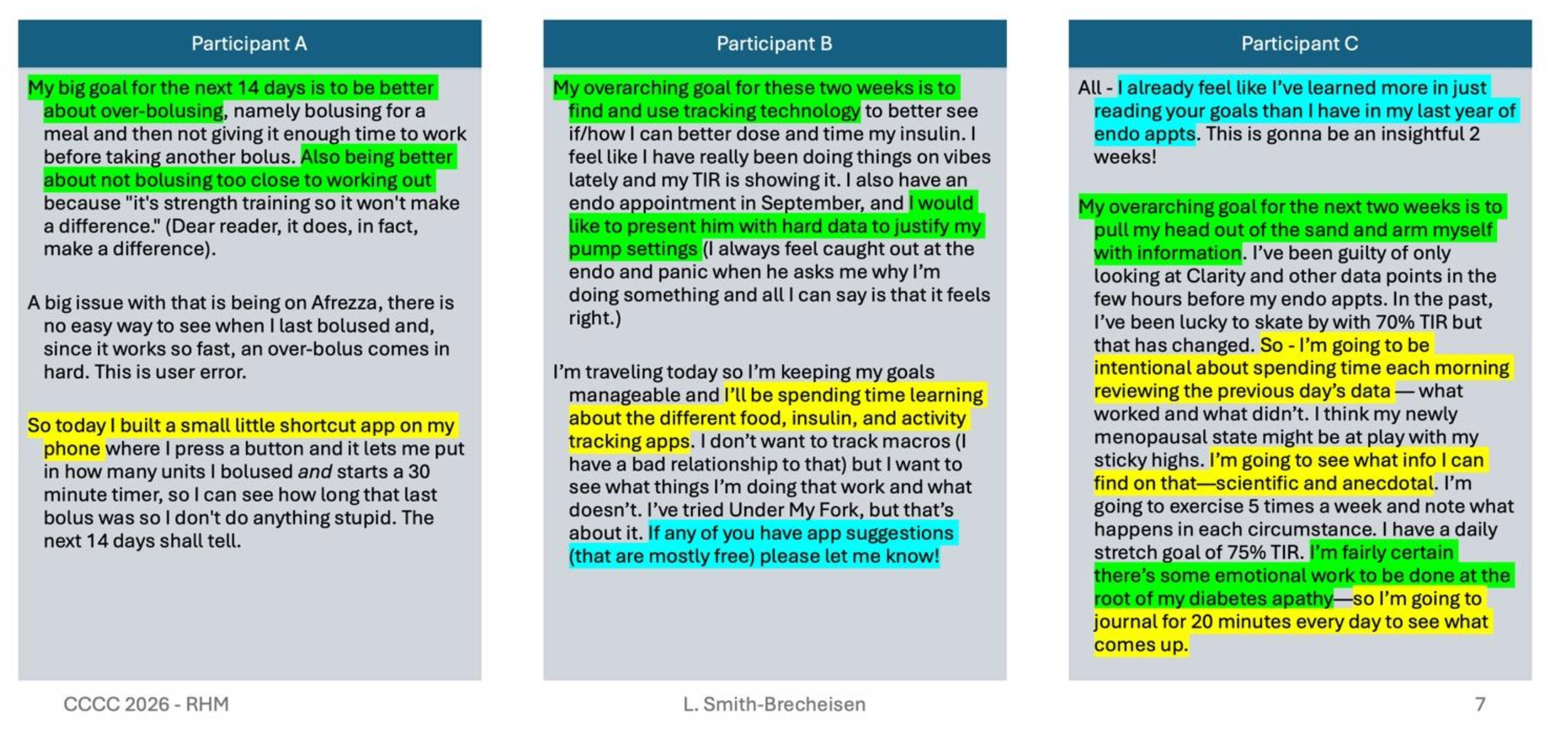
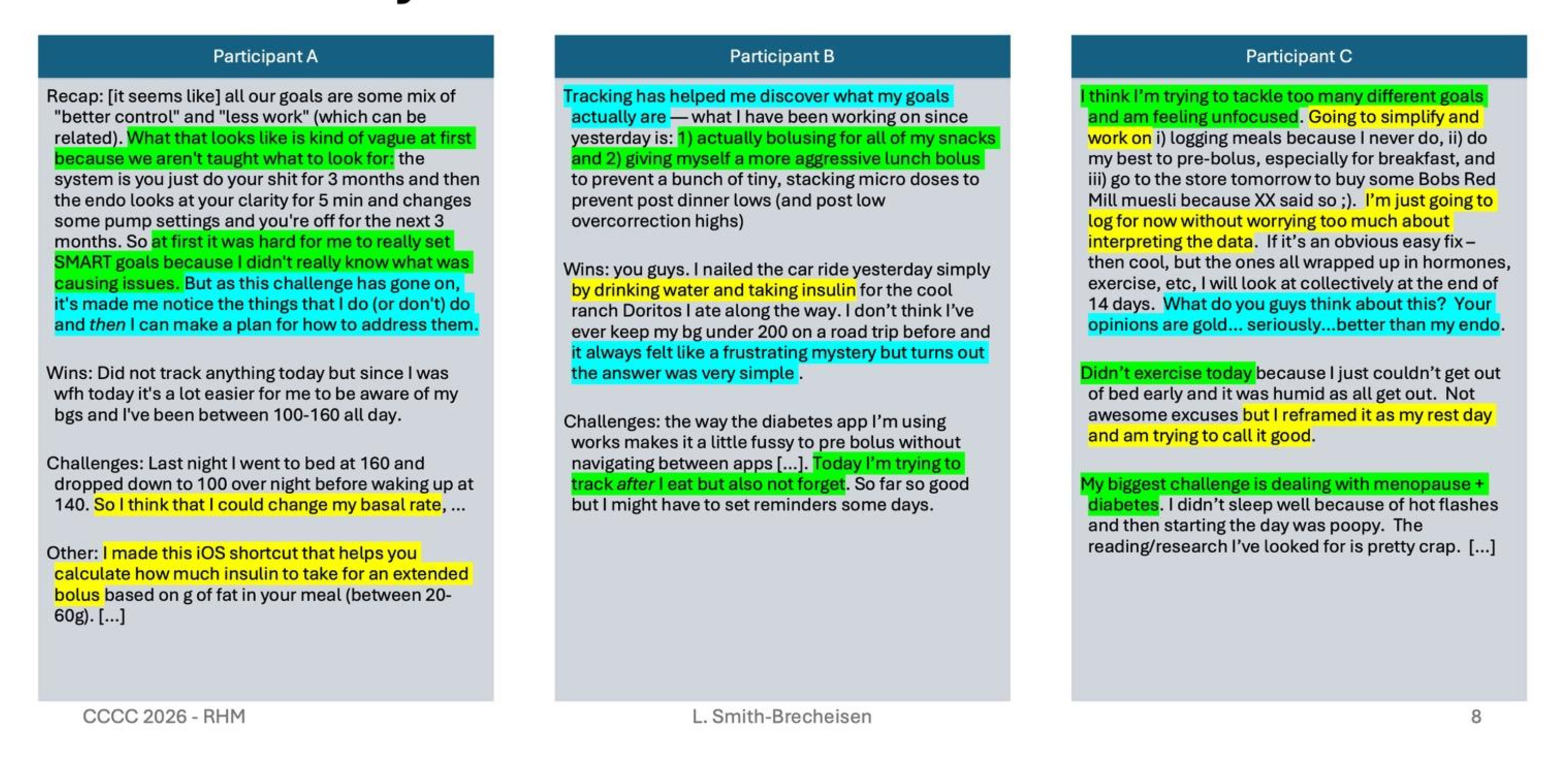
The daily management of diabetes is, of course, not really like writing a dissertation – unlike dissertation writers, we are never done doing diabetes (nor do we get an official title acknowledging our deep expertise). Yet these results suggest that there are some useful things that the medical community could borrow from the fields of higher education and writing pedagogy. Notably, the communities of practice created through accountability groups provide a space for PWD to tackle higher orders of learning like applying, analyzing, and evaluating within a supportive peer group.viii
I would like to end with two questions: how can HCPs and PWDs find creative solutions from the world of education and writing pedagogy? And how can educators bring those approaches more directly to patient populations?
Interested in joining an accountability group? Sign up for Beta Cell Foundation’s email list or keep an eye on their website for the next group. Interested in designing an accountability group for your practice or community? Connect with me on LinkedIn!